


Video: Roland FR 8x Accordion, Classical Free Bass Set, Bach performed by Dale Mathis 9/5/17
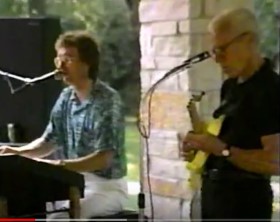
Pete Ayer is no longer here to motivate his students, but he lives on in the ways he challenged and changed their lives. He was the consummate teacher, having won the most popular teacher award on his campus several times. (Photo of Dale Mathis on keyboard and Pete Ayer on guitar)
I miss him.
I would call him occasionally and reminisce about driving home on snowy back-country roads after a Christmas party gig, or we would laugh about the New Year’s Eve job when I backed the truck over our drummer’s drums. Funny now, but we weren’t laughing that night, especially since I did it before the job started.
Although he was not my school advisor or counselor, he had a quirk for getting on his soapbox and expounding upon any subject that irked him. Early one Monday morning during my sophomore year, I stumbled into Western Music History class with a pounding headache. I slowly sat down next to two professional jazz musicians and commiserated about the inspirational benefits of alcohol on the job verses the next morning’s blues. The classroom was small and Professor Pete overheard our conversation.
It’s not that Pete was a puritan; I knew he occasionally enjoyed, with his evening vegetarian meal, the brewed brand that had made Milwaukee famous. More likely, I think he knew that alcohol was not a necessary ingredient in the creative process. I had witnessed his pontification speeches before, but they were never directed squarely at me. I could barely keep my bloodshot eyes focused on him, but I knew his medicine would go down easier if I didn’t make a fuss. The sermon ended with a challenge – to play an entire gig without one sip of alcohol.
College life was changing my world view, but his quip seemed as if it came at me like a flying saucer from Mars. Actually, that might have been more real. Little green men would have come out of their space vehicle and declared, “Thou shalt not drink on the job.” I could have accepted that and experienced a paradigm shift before the term became a cliché.
Drinking and silly talk, in my opinion, were the only reasons for taverns to exist – they were the cultural norm I had grown up with. The alcohol relaxed my inherited stiff moral codes, allowing an introvert like me to socialize easier. As the week wore on, his call-to-resist continued to irritate me like a grain of sand in my oyster. By the weekend I decided the only thing to do was to take him on.
We were playing at one of our favorite spots; the barmaid knew our drinking habits by heart. “Just bring me Coke tonight,” I lied, wondering if withdrawal anxiety symptoms would win. We had a great crowd and the night went well. While packing up our equipment, I wasn’t sure if my euphoria was from having won the challenge, or because my mind was still clear. I decided to repeat the Coke routine at the next evening’s job, after which I knew it was the exhilaration of playing music that made me feel good, not the alcohol. I resolved to quit drinking.
That may sound a bit extreme, but I was ready. I may also have been influenced by the militancy of the 1960’s anti-war Wisconsin college environment. My decision was a statement about exercising control over my life and how I fit, or did not fit in with what we used to call “the establishment.” Anti-establishment sentiment was big among my college friends, but so was binge drinking. In my mind, I had graduated that weekend.
I went to class on Monday morning with clear eyes, but Professor Pete had forgotten his challenge statement. What, apparently, had meant little to him may have provided me with a lifeboat, saving me from wallowing in the sinkholes of alcoholic despair that I have since witnessed family and friends get helplessly sucked into.
I was a kid, a year out of high school when I met Pete. My primary goal in life – to graduate – had already been attained. I worked a factory job by day, that’s what my family expected me to do because that’s what they understood. Only a few of them still worked the family farms. But there was something different about me. I had taken an interest in music and had started playing gigs in our small-town Wisconsin taverns. I played polkas and country music on my accordion. Seventeen dollars and all the beer I could drink was the compensation for my first New Year’s gig when 1965 declared, “Auf Wiedersehen.” I was fifteen.
For sanity’s sake, everyone I knew at the factory had an outside passion. Mine was playing music. I suppose it’s not strange that a summer course in music literature caught my attention, although I feel it’s highly unlikely that I would have changed my life’s direction if the class had not been taught by Pete. It was a colliding of his classical music world into my colloquial rendition. Without his compassion and enthusiasm, I may have suffered death-by- madrigal and dropped out after the first night.
When he spoke, he was able to bring out creative listening aspirations within me. It wasn’t the classical form that caught me; it was his pure love of music – he made it contagious. The only cure, it seemed, was to drop out of factory life and be inoculated with music class serum.
While others were being drafted into the Vietnam War, I enlisted my name onto the college roll. My deferment arrived in the mail on the same day as the letter from the Department of Defense requiring me to come in for an Army physical. School buddies who had made it back from Vietnam had a knowing in their eyes that I didn’t envy. Today, for all I know, meeting Pete may have curtailed my early demise.
Even though I knew his time was spread thin, I needed a new guitar player for my group just after I graduated from Pete’s campus. Over the next twenty years we played more than a thousand weddings, reunions, parties, and community events together. In our band, he provided the rhythm and vocal harmony. Symbolically, I might say that he provided a rhythm style for me to emulate with my life.
Playing in the band was fun; he managed to find time for it along with his other interests. He worked his apple orchard, swam in his pool, flew his airplane, and performed with his professional vocal ensemble. But his greatest passions were his wife Carol…and teaching.
A few years before we left Wisconsin, Pete and Carol retired from the University and moved to Florida. They enjoyed the warm winters and Pete took a part-time position as a flight instructor at a local airport. An eighty-year-old student asked if he would pilot both of them up to a New York reunion in the student’s home built airplane – and oh – something I forgot to mention, Pete was also the men’s national high-dive champion for men over fifty-five. On their return flight, somewhere off the Georgia coast, Pete found himself in a diving position that he could not pull out of. Authorities found the student’s body on the shoreline, but Pete and the airplane were not recovered.
My friend is no longer here to sing in harmony with me at a reunion concert, but the mark of his passion for music has been left upon me.
If Pete Ayer had been assigned to be my mentor, it must have been by the music angel. This is a public expression of gratitude to that angel; you did a great job. Please keep up your good work by pairing other meandering souls with teachers as passionate about life as Pete.
For further information: Dale Mathis, Sun City, AZ
suncityaccordion@aol.com
480-544-6016


