

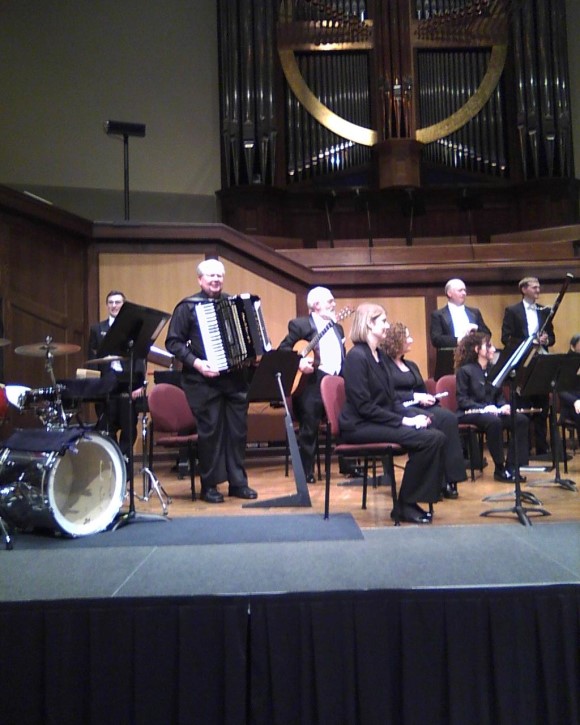
Friday and Saturday, January 23 and 24, 2015, Jay Landers brought his Excelsior 960 onstage to blend with the brass and woodwinds of the Illinois Symphony Chamber Orchestra, conducted by their Music Director, Alastair Willis.
This was a rare occurrence for both the orchestra and Landers, who has played in a number of musical theatre pit orchestras, but only three times onstage with a full orchestra or wind ensembles. This “No Strings Attached” program theme was extremely rare in the 22 seasons of the ISO’s existence. Maestro Willis is in his third season with the organization.
Jay Landers has played the piano accordion continuously since 1958, when he began lessons at Central Conservatory of Music in his native Louisville, Kentucky. He and his wife and children moved to Springfield, Illinois, in 1997.
The ISO Chamber winds maintained a rigorous rehearsal and concert schedule over three days. Throughout its 22 seasons the concerts have been divided between Springfield and Bloomington-Normal, due to the ISO’s formation from the consolidation of the Springfield Symphony Orchestra Association and the Bloomington-Normal Symphony Society.
Friday evening there were Two Concerts at 6pm and 8pm, in the sanctuary of the First Presbyterian Church, Springfield. Saturday evening’s performance at 7:30, took place in the sanctuary of the Second Presbyterian Church, Bloomington. There were approximately 200 patrons in the audience at each concert.
The entire program consisted of:
“Sonata plan’ e forte” Giovanni Gabrieli
“Serenade in E-flat Major, Op 7” Richard Strauss
“La Perl: Fanfare” Paul Dukas
“Symphonies of Wind Instruments (1947 version” Igor Stravinsky
“Klein Dreigroschenmusik” Kurt Weill
Okay, what was that last one, again? “Little Threepenny Music: Suite from ‘Threepenny Opera’”. The enduring melody from this is “Mack the Knife”! This is the piece on the program that required guest players, and there were five of them clustered on Stage Right: piano, tympani, percussion, banjo/guitar and accordion. Landers had a few lines in the Overture and Finale, but the primary reason for being was the “Tango Ballad”. The accordion’s personality was distinctly audible throughout this movement.
Jay Landers can be reached at jayloringlanders@outlook.com .


