

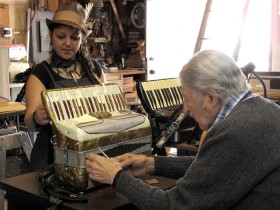
My interview was conducted in July 2007, in Penngrove, California at the annual Accordion Club of the Redwoods picnic. This is a summary of that delightful conversation with Vince Cirelli, December 21, 1920 – September 29, 2012
We started off the informal chat with a little Italian. I asked about his initiation into the craft and he carefully described how he got started in the accordion factories in North Beach. It was there that he learned to build a “fisa” the affectionate Italian nickname used for the accordion. Generally, he said, in the early days, it “took about a year to build one.” He was learning the craft back in the late 1930s; at that time, there were dozens of accordion manufacturers in the Italian neighborhood known as North Beach.
It was his father, Felice Cirelli, whose musical talents were passed onto Vince. Felice was just 18 when he arrived in San Francisco from San Marco Catola (Calabria) about two weeks after the 1906 earthquake. His first job consisted of picking up the bricks, and delivering them to builders who were reconstructing the city. He and his wife Costanza di Vincenza lived in North Beach; in 1920 Vince was born on Telegraph Hill between Union and Kearny. His father performed at an old Chinese theatre—“it was a vaudeville theatre in the Pacific International Settlement, known as the Barbary Coast.” The family continued to live in North Beach, on Broadway in San Francisco.
By the 1920s, the mainly Italian-owned accordion factories had started to proliferate. When Vince turned 12, his father bought him his first accordion, a rental from Joseph Colombo in 1932. It was a $5 a month rental for a year. The $60 was applied toward purchase. It was the Depression, and I’m sure this was quite a sacrifice for his father who ordered one built to fit Vince. One can only imagine what it was like for this teenager to wake up on any morning in North Beach to hear accordions being played, tested during construction and repair work, and hanging out at the Green Street barbershop (a musical hub in North Beach) to listen in on conversations about who was gigging.
He grew up in the midst of the finest Italian accordion caretakers; they must have inspired Vince to follow in the profession and to adhere to this fastidious hand-crafted tradition. Just as his father ‘repaired’ San Francisco by gathering together the bricks to be used and recycled, Vince loved to salvage accordions for restoration. His professional colleagues consisted of dozens of many immigrant Italians; he only mentioned a few during the interview: the Taffi brothers, originally with Guerrini Accordion, later with Standard Accordion, operated a repair business, mentoring to the young Vince. Another was Paul Greub, referred to by Vince as “Swedish” accordionist; his factory operated from 1924-1975. According to Vince, Galleazzi & Sons (Giuseppe, Frank & Theodore) was located at 478 Jackson, and opened in 1896, going out of business in 1944.
While the war interrupted and closed many businesses, it also resulted in Vince opening the doors to his own business in 1946. Cirelli Accordion Service started at 1238 Columbus St., then 2930 Geneva St, then 37 Leland St. in the mid-1970s, and then in 1981, he moved his accordion service to Valley Drive in Brisbane. Accordion factories, stores and academies survived well into the early 1960s, where a dozen or more were still listed in the Yellow Pages. In the late 1970s, Mike Corino’s music store (now Puccini Caffè) was one of the last to close its doors in North Beach. But it was Vince who continued to service the accordion community.
Vince loved to compare and contrast accordions. For example, he thought that Ernst Lund “built accordions to last like a battleship.” Long before the mass manufacturing in the late 1940s and 1950s, accordions tended to be built upon request. While a standard accordion could be easily bought, the professional players visited an accordion factory to be fitted for one, just as one might visit London’s Savile Row for a custom suit. An accordion had to complement the individual player’s physical dimensions. In the course of his apprenticeship, he met a fellow named Gallenstein, who invited Vince to learn to repair accordions. Later, Gallenstein went on to head up Hohner. In the mid-1990s, Rubin Boaz went to Cirelli’s shop to learn, and to Gordon Piatanesi’s (Colombo Accordions) before it folded. Vince called Boaz a ‘good machinist’ and attributed Boaz’s repair skills to having been in the jewelry repair business before he opened Boaz Accordions. His legacy survives because he cared deeply about the accordion’s beauty and physical health.
Vince lit up when he recalled meeting Skyler Fell in 2005. He had several good years teaching Skyler his ‘hands-on’ repair method, by using all five senses. As he began to describe to me how to build an accordion for someone, or to buy an accordion, he emphasized how important it was to examine the whole person. He believed in a close examination of the person’s body, especially arms and hands. Vince sized me up as he unconsciously began to take measurements as if he were building a custom accordion for me. In fact, Vince told me that “all the plans for building an accordion were [stored] in his head.” An amazing feat at any age!
We loved you, Vince. He will be missed by his family, friends and fellow accordionists around the world.
Note: All names, addresses, dates, and quotation marked statements were Vince’s. Upon verification in the Flynn and Davison’s Golden Age of the Accordion, it was clear to me that Vince had an extraordinary ability to remember details even in his ninth decade.
For further information:
Sheri Mignano Crawford
E-mail: Zighi@sonic.net
Photo of Skyler Fell and Vince Cirelli

