

Interview with Accordionist Dr. Ian Blair Fries, Orthopedic and Hand Surgeon
March 1st 2011
Rita Davidson Barnea
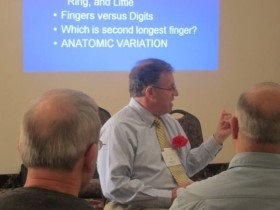
I had the pleasure to meet and interview Dr. Ian Fries from Florida and New Jersey at the January 2011 FMAE (Frank Marocco Accordion Event). Ian is an orthopedic and hand surgeon who graciously shares his knowledge of hands with accordionists at conventions and festivals. His practical advice is helpful to amateur and professional musicians.
R: How did you get involved with the accordion?
I: I grew up in New York City. I started to play accordion as a teenager. I was not very good, but was lucky to have Paul Martell as my accordion teacher. He was an accomplished accordionist, and resident band leader at Roseland Dance Hall in NYC. He also played for the Harvest Moon Balls. That’s why some of my style is from the era of large dance bands like his.
I remember him fondly. He had never taught accordion, and took me on as a favor to friends of my parents. When we first met it was in his back stage dressing room. He strapped me into his full size accordion, using baling string in an attempt to shorten the straps. It was clearly too big for me, as I could barely look over the top. He then looked at me, trying to figure out what sort of lesson he should provide. He finally asked me what song liked. I said “Around the World in 80 Days” which was popular then. He quickly wrote it out in the key of C, and that’s how I learned to play music.
A few lessons later he told me I needed $25.00. Lessons then were $5.00, and $25.00 was a lot of money. So, I went home and my parents trustingly gave me money for Paul. A few lessons later, he presented me with my first fake book. Back then fake books were sold “under the table,” and were only for professionals. He taught me to play music from lead sheets – and I still do.
I stopped playing for about twenty years. Then, about four years ago I saw a young lady for a hand surgery consultation. She had sustained a terrible hand injury, and her fingers were close to immobile. I then did something I always like to do. I asked, “How does your hand bother you the most?” She started crying, and said, “Nobody ever asked me that question, and I really never wanted to tell anyone. The real problem is I can’t play accordion anymore.”
Well, that night I went home and took out my accordion, and started to play again. The keys were sticking, because it had not been played in such a long time. I went on line and found the son of the man who had sold me that accordion was still in business. No longer in New York City, Accordion-O-Rama was South Amboy, New Jersey, not far from my home.
When I brought my accordion in for repairs, Peter Shearer told me about an accordion meeting in Texas three weeks later. He encouraged me to go, and as I happened to have the time I decided to take his advice. And that was my introduction to the accordion world.
I called Norman Seaton about the meeting, and found out he was a pilot, as I am. He kindly invited me to a pre-meeting dinner at German restaurant in Dallas. When I arrived, people were playing the accordion all over, and I could not believe how good they were. I decided to keep a low profile, and noted a man sitting in a corner quietly playing. I said, “You really play beautifully.” That was Joe Vento! He is a fantastic accordion player. I also met Dick Albreski who courteously advised I was not even wearing my accordion properly. I was lucky to have such professionals helping me.
R: When did you start doing workshops for accordion organizations?
I: After I attended the Texas Accordion Association meeting (now the NAA), I asked the coordinators what I could I do to return the favor to the many who had helped me. And that’s when I started doing seminars.
R: What is your workshop about?
I: I call it “Medical School 101.” I like to give accordionists the flavor how we physicians look at the hand. Typically I teach a little hand anatomy, physiology (function), pathology (how things can go wrong), and therapeutics (how we fix hands). I focus on topics of importance to an accordionist, and I like to open the floor to questions and answers.
R. Can you give an example of your teaching.
I: I discuss protecting hands from injuries. You may not be able to prevent arthritis, but most hand injuries are preventable. All accordionists, amateurs and professionals, should realize how important their hands are – before not after they are injured. I hear of professional accordionists who can ill afford hand injuries doing risky things – using table saws, sharping knives, hammering nails, and allowing their hands to come in contact with corrosive chemicals. They should avoid lawn movers or snow blowers, as I see too many injuries from such devices. Accordionists should carry gloves with them – a pair of work gloves and a pair of rubber gloves. If you have them, you are more likely to use them.
R: Your workshops are unique.
I: Thank you. I have been fortunate to have my seminars so graciously received by accordionists.
R: What is your educational background?
I: I went to Columbia College, and Columbia University College of Physicians and Surgeons. I had post doctoral training at New York Hospital – Cornell Medical Center, and Hospital for Special Surgery.
R: Which festivals have you attended, and at which have you given seminars?
I: The NAA, now for my fourth year, Dale Wise’s Repair Seminars twice, and this is my second FMAE. I will present two workshops at the NAA on March 11 and 12, 2011. I am a member of the Flying Musicians Association, and under their auspices have played at various airport functions from Cannes, France to Long Beach, California.
R: Where do you live?
I: in Mantoloking, New Jersey; and Vero Beach, Florida.
R: If someone wants to reach you, how can that be done?
I: I participate in several online accordion Yahoo groups, and can be reached at ibfmd@cybercomm.net. I enjoy meeting and speaking with accordionists.
R: Thank you for taking the time for this fascinating interview.


