

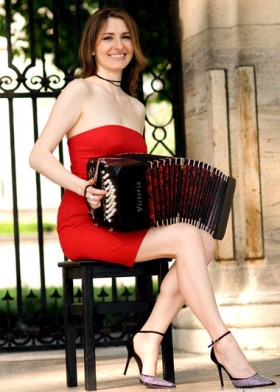
This is perhaps the first time – ever – and certainly during the 10-year tenure of Music Director Karen Lynne Deal, that a “free reed” instrument has fronted the Illinois Symphony Orchestra. That was the case when Lidia Kaminska traveled to Springfield, IL, to present Two Concerts of the Piazzolla “Double Concerto for Guitar and Bandoneon” with fellow soloist Jason Vieaux on November 12 and 13.
The symphony’s program booklet included a “Concert Season Welcome” from Maestra Deal, which mentioned “With talent abounding this season, I know you will want to share the artistry of Roberto Plano, Lidia Kaminska, Soovin Kim and others.” The performances in Bloomington and Springfield were entitled “Fiery Fun”, and the orchestra and soloists made good on their promise!
The evening opened with Igor Stravinsky’s Suite from “The Firebird” ballet and closed with Alberto Ginastera’s “Estancia” Suite from the ballet, Op. 8a. The rhythms, accents (at times the timpani had audience members jumping in their seats) and melodies were engrossing and memorable, and they provided the perfect Prelude and Postlude for what occurred in-between.
Lidia and Jason had not collaborated musically prior to their joint appearance with the Illinois Symphony. This being their first collaboration, it was their musical artistry and symbiotic relationship that made their presentation of the “Double Concerto” totally relaxed, playful (often exchanging smiles following certain passages) and electrifying with their combined senses of rhythm and melody. The blending of sound was superb. This piece is written for chamber orchestra, so the bandoneon and guitar do not have to compete with an entire stage full of musicians. There was just a bit of sound enhancement for the guitar and there were no issues with being able to hear the bandoneon.
The two remaining orchestral pieces on the program included Piazzolla’s “Oblivion”, which featured the symphony’s principal oboe as soloist, Orion Rapp. Jacob Gade’s “Jealousy” opened the second half of the program. It’s been used in over 100 films and was “discovered” by Arthur Fiedler, not long after he began his 50-year reign as the Conductor of the Boston Pops Orchestra. Once he had it scored for orchestra and included it in his Pops concerts, its popularity demanded that it should be part of the orchestra’s very first recording session. Consequently, it was the first-ever recording of this melody.
Jason Vieaux, Head of the Guitar Department at the Cleveland Institute of Music, recently joined the faculty of the Curtis Institute of Music along with respected guitarist David Starobin. The Curtis Institute will be inaugurating its guitar department in the Fall, 2011. Jason’s an active recording artist, too. He joined Lidia in the second half of the concert with an improvisational tour de force of “Café 1930” from Piazzolla’s “History of the Tango”. Each performer had offered a brief solo, and then presented this piece as a duet, which they apparently put together on Thursday, November 11, when they arrived in Springfield for the orchestra rehearsal. They also presented it on WILL-FM, public radio from the University of Illinois in Champaign-Urbana, on the midday series “Live and Local” on Friday, November 12. The entire concert will be broadcast on WUIS-FM, public radio from the University of Illinois Springfield campus.
It should be mentioned that Trevor Orthmann, Executive Director of the Illinois Symphony Orchestra, was in orchestra management in the Philadelphia are before arriving in Springfield in his present position one year ago. He knew first-hand of the popularity and talent that Lidia Kaminska created and offered to audiences. Classical music and tango enthusiasts alike, not to mention those of us in the accordion community, owe a debt of gratitude to Trevor for bringing Lidia to Central Illinois.
Lidia Kaminska is a native of Poland and holds multiple degrees in music, including a Master’s from the Chopin Academy of Music in Warsaw, and is the only person in the U.S. to receive a Doctorate in Accordion Performance from the University of Missouri – Kansas City, under the direction of Joan Cochran Sommers. She plays the chromatic accordion, an exquisite Zero Sette, and taught herself to play the bandoneon, a model crafted by Victoria, in 2007.
Many audience members, especially in the “Concert Comments” dialogue between Lidia, Jason and Karen Lynne Deal and the early arrivals among the audience members which preceded the evening’s performance, expressed that the bandoneon sent them to reference sources to find out about the instrument. The symphony’s program notes state “…a type of button-accordion, or concertina, developed in Germany about 1840, which became the principal solo instrument connected with the tango in Argentina at the beginning of the 20th century.” Lidia mentioned the German origin of the instrument, and credited Heinrich Band, with giving the instrument its name “bandoneon”. According to Henry Doktorski’s “A Short History of the Free-Reed Instruments in Classical Music”, several individuals over the period 1835-1850, have been credited with inventing it and/or advertised its availability. And, there was a variety of button-board systems.
Lidia admits that having played the chromatic accordion for over 20 years prepared her for the chromatic bandoneon, but the button-board is extremely complicated and is a “mirror” of her accordion. When you watch her play, her fingers are working feverishly all over the button boards of the treble and bass with big reaches in order to hit the notes. There is a “diatonic” bandoneon, which changes the note depending on the direction of the bellows.
Here are some other considerations for the traditional accordionist, if you’re contemplating taking up the bandoneon. The accordionist pulls and pushes the bellows with the left hand/arm. The bandoneon player uses both hands. That takes a lot of getting use to. There are no registers on the bandoneon. There are three octaves in both the treble and bass. It appeared that different size buttons tell the player the octave of that button. While many performers are seated on stools with the bandoneon resting on their leg, Lidia chooses to stand. She places her left foot on a low piano bench and rests the instrument on her left leg.
Lidia Kaminska makes her home in Philadelphia. She’s part of an “emerging artist” network called Astral Artists. She’s on a mission “to rehabilitate the accordion’s reputation with classical music audiences.” Most of her orchestral appearances are with the bandoneon. This year she toured for four months (April thru July) with Cirque du Soleil (and previously toured with them in October and November, 2009), and that was with her accordion. She performed George Gershwin’s “Rhapsody in Blue” with the Philadelphia Classical Symphony this past April. These are just the tip of the busy performing schedule Lidia manages to maintain.
You can read about and contact Lidia at www.lidiakaminska.com or lidiak@lidiakaminska.com .


